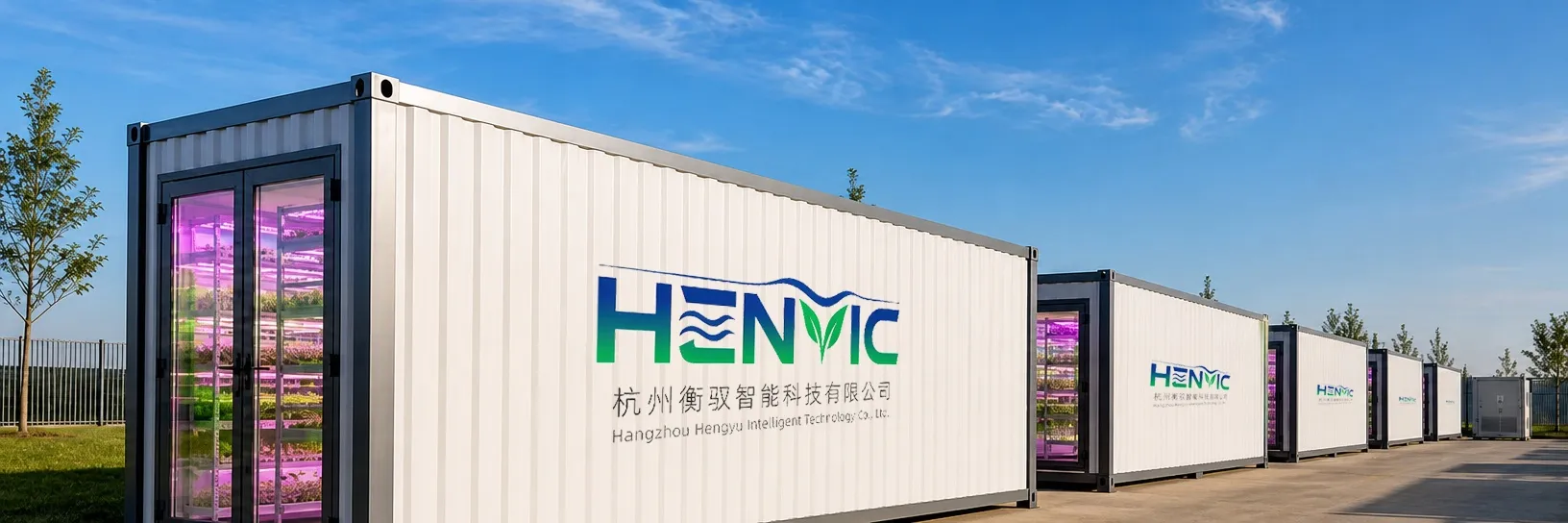
Agriculture has always been a negotiation with the weather, and for most of history the weather has held the stronger hand. A late frost, a heat dome, a month without rain, a hailstorm on the wrong afternoon—any one of these can erase a season's work. What has changed is the frequency. Climate volatility has turned once-rare events into recurring features of the growing calendar, and the farmers absorbing those shocks are the ones with the least capacity to absorb them. The container farm's claim is modest but consequential: it does not stop extreme weather, but it can move the crop out of its path entirely.
The Problem Is Variance, Not Heat
It is a mistake to read climate risk as a simple trend toward warmer averages. The damage comes from variance—from swings that break the assumptions embedded in every field operation.
A crop calendar is a set of expectations: this variety planted on this date will see roughly this temperature range and this much water, and will be ready to harvest in this window. Extreme weather breaks the expectations. An unseasonal heat spike during flowering can sterilise pollen and cut fruit set. A warm winter fails to trigger the chilling that perennial crops need to break dormancy. A sudden cold snap after an early warm spell kills buds that had already opened. Heavy rainfall saturates soil, drowns roots and spreads fungal disease; the drought that follows a few weeks later does the opposite.
For leafy greens in particular, the vulnerabilities are acute. They are shallow-rooted and thin-leaved, sensitive to both heat stress and waterlogging, and quick to bolt when temperatures spike. A single heatwave can turn a field of lettuce bitter and unmarketable within days. The problem is not that the average is shifting; it is that the field has no way to buffer the extremes.
The Sealed Environment as a Buffer
A container farm's answer is to remove the crop from the variable system altogether. The box is a sealed, actively controlled environment, and its defining feature is that the outside weather is largely irrelevant to what happens inside.
Temperature is held within a narrow band regardless of the heat or cold outside. Humidity is regulated, which suppresses the fungal diseases that wet weather encourages. Water arrives through a recirculating nutrient solution rather than from rainfall, so a drought is a non-event and a flood never reaches the root zone. Light is supplied by LEDs, so an overcast month or a hailstorm that would shred a field is reduced to a line of no consequence in the operating log. The crop experiences a version of the climate that never varies, and the harvest schedule holds.
This is a genuine form of resilience, and its value is easiest to see in the places where conventional agriculture is most exposed: regions with growing water stress, areas where heatwaves have become routine, and coastal or island settings where a single storm can sever supply lines for weeks.
The Case of Disrupted Supply Chains
Extreme weather does not only destroy crops in the field. It destroys the transport that moves them. Flooded roads, closed ports, grounded flights and damaged rail lines can isolate a region from its food supply even when the food exists somewhere else. In these moments the vulnerability is not agricultural but logistical.
A container farm situated within the affected region is, by design, inside the perimeter of the disruption. It does not need to import produce across a broken road network, because it grows the produce where it is consumed. Its inputs—power, water, nutrients—are comparatively easy to stockpile or secure in advance, and a modest reserve of nutrient salts and spare parts can sustain weeks of production without any external resupply.
For islands, remote communities, disaster-prone coasts and landlocked regions with narrow supply corridors, this is more than a marketing point. It is a genuine hedge. A city that grows a portion of its perishable greens locally has a buffer that the long supply chain cannot provide, and that buffer matters most precisely when the chain fails.
Where the Logic Strains
The resilience argument is real, but it is not unconditional, and the honest version of it names the limits.
The first is energy. A sealed, artificially lit container depends on a continuous power supply. In an extreme weather event, that dependence is also a vulnerability: a grid failure takes the farm down as surely as a flood takes down a field. Without backup generation or storage, the container's climate resilience becomes contingent on grid resilience. Operators who take the argument seriously install emergency power, but that raises capital cost and is frequently omitted in cost-sensitive projects.
The second is the type of crop. Container resilience applies to what containers can profitably grow—leafy greens, herbs, microgreens and similar short-cycle, high-value crops. It does not extend to the staples that form the bulk of a population's calories. Wheat, rice and maize are grown on vast acreage at costs the container model cannot approach, and no stack of boxes will substitute for a failed grain harvest. The container is a resilience tool for a narrow slice of the food system, not a shield for the whole of it.
The third is the carbon question. Climate resilience achieved through energy-intensive production is only a coherent answer if the energy is clean. A container farm running on a coal-heavy grid contributes to the problem it claims to mitigate, and its resilience credentials are weakened in proportion. Paired with renewables, or sited where the grid is low-carbon, the logic holds; without that, it is a partial solution carrying its own contradiction.
Resilience as Design, Not Accident
What distinguishes the container farm from conventional protected agriculture—greenhouses, high tunnels, shade houses—is that its resilience is a property of its design rather than a favourable accident of location.
A greenhouse still depends on ambient conditions for temperature, light and ventilation; it buffers the weather but does not leave the system. A container, by sealing and controlling the environment completely, detaches from ambient conditions in a way a greenhouse cannot. The cost of that detachment is energy, and energy is the price of the resilience. Nobody gets climate independence for free.
The design consequence is that the container's value is highest where the ambient climate is least reliable. In temperate regions with stable growing seasons, the case is weaker—the field already works, and the container's added control buys less. In regions facing water scarcity, chronic heat stress, storm exposure or fragile supply chains, the value of removing the weather from the equation rises sharply. The technology is not uniformly advantageous. It is advantageous where the weather has become the binding constraint.
What the Container Can and Cannot Guarantee
Read plainly, the container farm offers a specific and limited guarantee: the crop inside the box will not be lost to a drought, a flood, a frost or a heatwave. It will not be lost to the weather at all. That is a guarantee no field can make, and in an era of intensifying climate volatility it carries real value.
What it cannot guarantee is everything else. It cannot survive a prolonged power outage without backup. It cannot feed a city, or replace the staples that depend on open ground. It cannot claim environmental virtue if it runs on dirty electricity. And it cannot make money on commodity prices, which means its resilience is available only to those who can pay for it—a limitation that is uncomfortable but real.
Within those boundaries, the value proposition holds. Extreme weather is becoming the norm rather than the exception, and every year the growing calendar includes more days that no field can absorb. The container farm does not fight the weather. It declines to participate in it, and that refusal, priced honestly, is the product it sells.