A container farm's economics are decided less by how much it can grow than by how much electricity it must buy to grow it. Because the box severs every free exchange with the outdoors—sunlight, ventilation, thermal buffering—each environmental service that a field or greenhouse obtains at no cost must instead be paid for in kilowatt-hours. The energy ledger of a container farm therefore is not a supporting spreadsheet appended to the business plan; it is the design constraint that determines whether the operation can exist at all. And within that ledger, two line items dominate and are physically welded together: lighting, which supplies the photons, and cooling, which removes the heat those photons inevitably deposit. The central design problem is not "how do I reduce the electricity bill," but "where does further optimization stop paying for itself."
1. Why the Ledger Is the Decisive Variable
The defining feature of a container farm as an energy system is that it is fully enclosed and artificially lit. In a greenhouse, solar radiation is free and ventilation can reject excess heat passively; in a container farm, both functions are purchased. The consequence is that energy is not a marginal operating cost but the principal determinant of unit economics—and the industry's recent history bears this out. The wave of high-profile vertical farming failures after 2023 has been attributed largely to high capital investment combined with high energy consumption, with several overseas leaders in the sector becoming the most visible casualties. Any credible container farm design must therefore be built backward from an energy budget, not forward from a growing area.
2. The Two Dominant Loads and Their Coupling
Lighting: The Manufactured Resource
All illumination in a container farm is generated electrically, which means the lighting load scales directly with the delivered light quantity—the daily light integral (DLI)—and inversely with fixture efficacy, measured in micromoles of photosynthetically active photons per joule (μmol/J). Two implications follow.
First, the lighting load is the largest single electricity consumer in most container farms, because it operates for the entire photoperiod and must supply the full photosynthetic requirement of every tier. Second, and more important, the practical way to reduce it is not to reduce the crop's light but to raise the efficacy of the fixtures that deliver it. LED efficacy has improved substantially and continues to do so, and this improvement is the single most powerful lever on the entire ledger: it lowers lighting energy and, as shown next, cooling energy simultaneously.
Cooling: The Tax on Every Watt
Nearly all electrical energy delivered to the LEDs becomes heat inside the sealed box. A fixture converts only a fraction of its input into photons, and even those photons are absorbed by the canopy and converted to heat; the remaining input is dissipated directly. In a greenhouse this heat drifts away; in a container it accumulates and must be removed by the refrigeration system. Cooling is therefore not an independent load but a tax levied on the lighting load—proportional to it, and compounded by the coefficient of performance (COP) of the cooling system.
This coupling is the most important structural fact in the energy ledger. Improving fixture efficacy reduces the lighting bill directly and reduces the heat rejection requirement indirectly, so the true value of a higher-efficacy fixture is larger than its nominal watt savings suggest. Conversely, treating lighting and cooling as separate line items—optimizing one while ignoring its effect on the other—produces a systematically misleading picture of where cost actually sits.
3. The Secondary Loads
Beyond the lighting–cooling pair, several smaller loads complete the ledger.
Dehumidification. Transpiration continuously loads the sealed air with water vapor, which must be removed to hold the vapor pressure deficit (VPD) within the range the canopy requires. Dehumidification by condensation also removes sensible heat and reheats the air; desiccant systems add regeneration heat. Because moisture control is inseparable from thermal control, dehumidification energy is entangled with the cooling load rather than separable from it.
Air circulation. Multi-tier vertical systems require fan energy to distribute air evenly through each tier, thinning leaf boundary layers and preventing dead zones. This load is modest relative to lighting, but it is continuous and, in poorly designed airflow systems, must be oversized to compensate for non-uniform distribution.
Pumps and dosing. Nutrient solution circulation, dosing, and aeration consume relatively little, but they run continuously and their reliability matters more than their magnitude.
Controls, sensors, and CO₂ enrichment. Instrumentation and injection systems are comparatively small consumers, though CO₂ supply in a sealed box carries both a consumable cost and, where supplied mechanically, an energy cost.
The practical point is that these secondary loads, while individually small, collectively set the floor below which total consumption cannot fall—so the achievable optimization of the dominant pair is bounded by the overhead they impose.
4. The Ledger's Proper Unit: Energy per Unit of Yield
A container farm's energy account is only meaningful when normalized to output. Total kilowatt-hours per box says nothing about viability; kilowatt-hours per kilogram of harvested crop is the metric that connects the ledger to the business. This normalization changes the optimization logic in two ways.
First, it rewards yield density. Because a fixed envelope of lighting and cooling overhead must be paid regardless, growing more crop per unit of conditioned volume—more tiers, higher planting density, shorter cycles—amortizes that overhead across more output and lowers energy per kilogram.
Second, it reframes "reducing energy" as "reducing energy per kilogram." Cutting light intensity lowers the electricity bill but also lowers yield, and if the yield falls faster than the energy it can raise energy per kilogram while weakening the product. The ledger's objective is not minimum consumption but minimum consumption per unit of usable output.
5. The Optimization Boundaries
With the structure established, the levers can be placed on a common footing: each reduces energy per unit yield up to a point, beyond which it stops repaying its cost.
Fixture efficacy. The primary lever, as noted. Because it reduces both the lighting and the coupled cooling load, its benefit is compounded—but it is bounded by the physical limits of LED technology and the capital cost of replacing fixtures. Improvement is continuous rather than free.
Heat recovery and internal reuse. Because lighting heat is generated inside the box, it is in principle available to be recovered rather than merely rejected. In cold operating environments the recovered heat can offset space heating; in all environments, reducing the heat load itself (via efficacy) is more valuable than managing it. Heat pumps can further raise the effective COP of the cooling function by linking it to useful heat delivery.
Envelope insulation. The box's thermal behavior depends on its insulation quality. Better insulation does not remove lighting heat—that heat is internal, not infiltrated—but it reduces the load imposed by ambient conditions, which matters most in extreme climates and during dark periods when lighting is off.
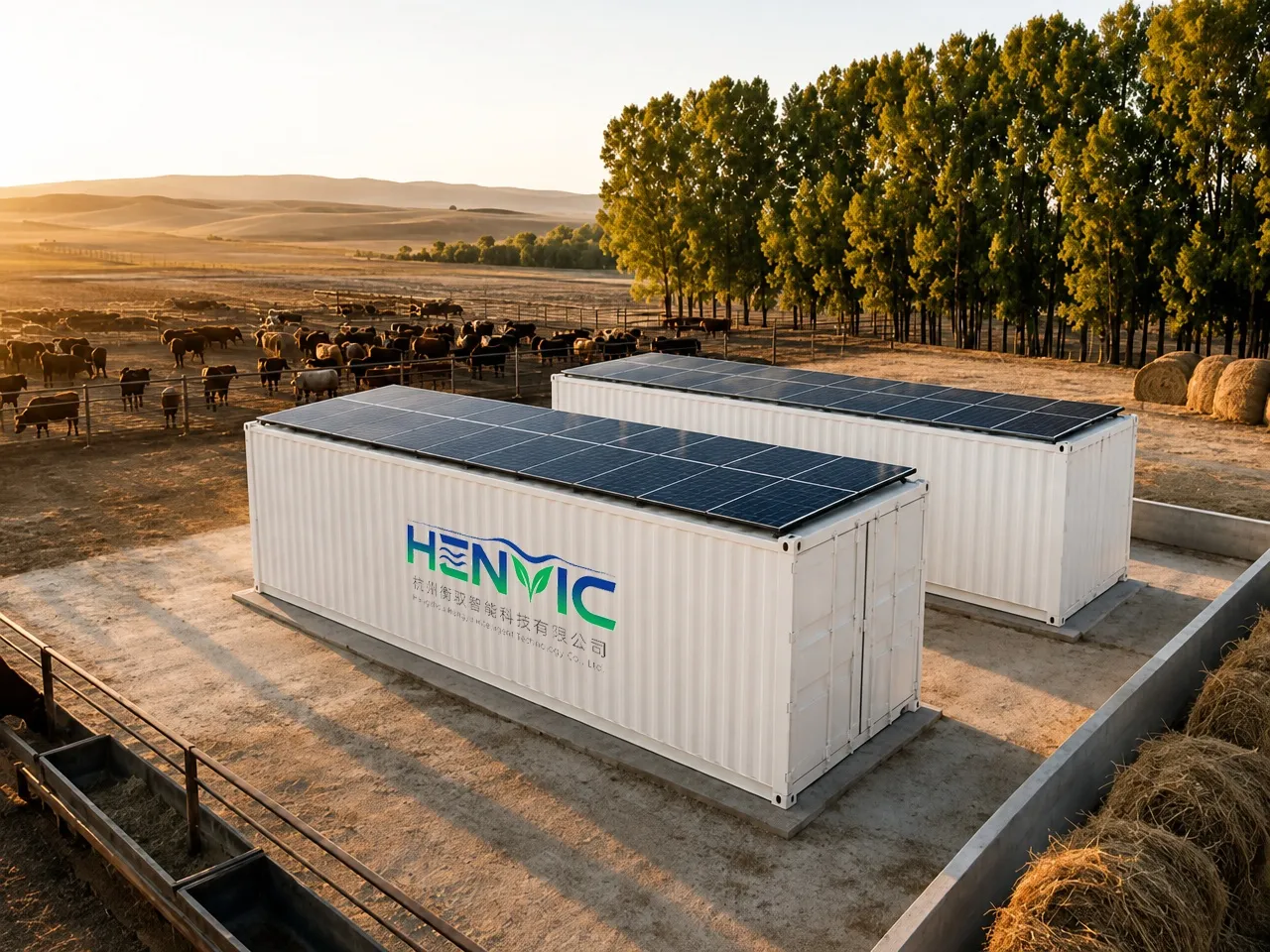
On-site generation. Photovoltaic (PV) generation coupled with the facility has been shown, in published vertical-farming research, to improve yields and reduce carbon footprint substantially—one modular design study reports a carbon footprint of roughly 0.468 kg-CO₂eq per kilogram of vegetable when solar integration is combined with improved production, alongside a significant yield increase. The limitation is intermittency: PV output does not match the indoor photoperiod and cooling demand, so without storage or grid interaction it displaces only part of the load. Storage adds capital cost and round-trip losses, and the economics depend heavily on local tariffs and grid carbon intensity.
Water and nutrient recovery. Where recirculating systems are used, closed-loop water treatment has been reported to recover 92–95% of nutrient solution and reduce water use by 70–95% relative to conventional irrigation. These savings are water, not electricity, but they reduce the pumping and make-up load and are part of the broader resource ledger.
Operational strategies. Shifting light delivery to coincide with periods of cheaper electricity (where time-of-use tariffs exist), and coordinating the photoperiod with cooling availability, can lower cost without reducing yield. Stage-aware light recipes, which concentrate photon delivery on the growth stages most responsive to light, improve energy per unit yield by avoiding peak intensity on less responsive stages.
6. Where the Boundaries Bind
The limits of optimization are not financial alone; several are physical or structural.
Photosynthetic saturation. Beyond a species- and stage-dependent PPFD, additional photons increase heat load more than they increase growth, so the marginal return on light—and hence on the cooling it drags along—declines. Pushing past this point raises energy per kilogram.
The second law. The COP of any cooling system is bounded, and as the required cold-side temperature falls, the pressure ratio and energy per unit of heat removed rise. Aggressive dehumidification and deep cooling therefore cost disproportionately more than modest conditioning.
Envelope-bound yield. A container's output is capped by its volume, and the fixed overhead of lighting, circulation, and controls is amortized over that fixed output. This is why yield density—the number of productive tiers and the planting density within them—is itself an energy-efficiency variable, and why the spatial design of the box and the energy ledger cannot be optimized independently.
Capital versus operating trade. Every efficiency improvement—higher-efficacy fixtures, better insulation, heat recovery, PV and storage—is a capital investment repaid through operating savings. The investment's viability depends on the discount rate, equipment lifetime, tariff structure, and utilization rate, so a measure that pays back quickly at high utilization may never recover its cost at low utilization.
7. Reading the Ledger as a Design Instrument
The most useful way to treat the energy ledger is not as a post-hoc accounting exercise but as an up-front design instrument. Reducing the three quantities that appear in the numerator—lighting energy, cooling energy, and the secondary overhead—and raising the output in the denominator are the only two routes to a lower energy cost per kilogram, and every design decision, from box insulation and tier count to fixture selection and airflow architecture, moves one or both. Because lighting and cooling are coupled, decisions made in the lighting design propagate directly into the cooling load, and decisions made in the spatial design set the envelope over which fixed overhead is amortized. The ledger is therefore a systems problem, and the boundary of optimization is the point at which the next marginal unit of capital spent on efficiency no longer returns more than it costs—measured in energy per kilogram, at the facility's actual utilization and tariff.
It should be noted that the principles discussed here—the dominance and physical coupling of lighting and cooling loads, the role of fixture efficacy as a compounded lever, the normalization of energy to unit yield, and the capital-versus-operating character of efficiency investments—reflect established understanding in controlled-environment agriculture and energy engineering. Specific values such as load shares, COP figures, DLI and PPFD targets, PV contribution fractions, payback periods, and carbon intensities vary substantially with climate, tariff structure, crop choice, box insulation, equipment selection, and utilization rate. The published results cited here describe particular studies under particular conditions and should not be generalized as typical. Actual energy budgets and optimization decisions should be built from measured consumption, site-specific tariffs, equipment specifications, and empirical commissioning data for the particular installation, and this article provides a framework for organizing the energy analysis rather than values for any specific system.