Introduction
The mushroom cultivation container industry represents a specialized and rapidly growing segment of controlled-environment agriculture (CEA), dedicated to the production of edible and medicinal mushrooms within modified shipping containers or purpose-built modular enclosures. Unlike leafy green container farms, which have become relatively standardized in their hardware and crop protocols, mushroom container cultivation is more biologically complex, more diverse in species, and more operationally nuanced. This diversity creates a rich but fragmented industry landscape, with significant variations in technology, crop targets, and business models.
This overview provides a structured understanding of the mushroom cultivation container industry—its market structure, core technologies, biological foundations, key players, and the unique challenges that distinguish it from other CEA sectors.

1. Industry Definition and Market Landscape
1.1 What Is a Mushroom Cultivation Container?
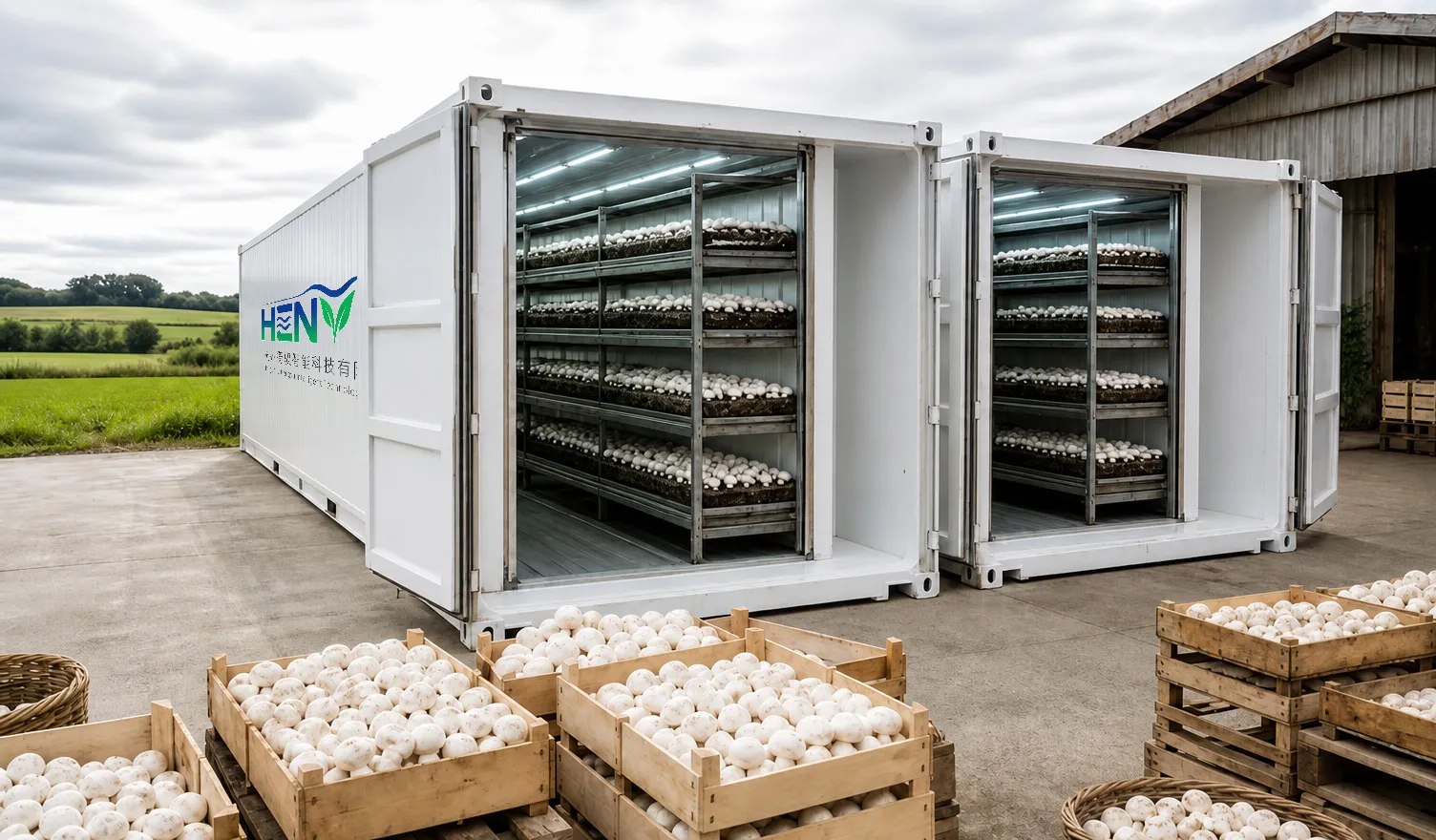
A mushroom cultivation container is a climate-controlled growing system built within a standardized shipping container (typically 20 ft or 40 ft ISO dimensions) or a custom-fabricated modular enclosure. It integrates environmental monitoring, HVAC climate control, sterilization infrastructure, substrate handling equipment, and automated climate management to produce mushrooms—such as shiitake, oyster, king oyster, enoki, beech mushrooms (shimeji), and specialty medicinal species—in a sealed, pathogen-controlled environment.
The key distinction from plant container farming is that mushrooms are heterotrophs: they do not photosynthesize but instead derive nutrition from decomposing organic substrates. This fundamentally changes the technology stack, the environmental priorities, and the operational workflow.
1.2 Market Size and Growth
The global mushroom market was valued at approximately USD 60 billion in 2024, with edible mushrooms accounting for the vast majority of volume and medicinal mushrooms representing the high-value growth segment. Container-based mushroom farming represents a small but rapidly expanding share of total production, driven by:
• Premium pricing for consistently high-quality, year-round mushroom supply
• Urban and peri-urban demand for fresh specialty mushrooms unavailable through conventional supply chains
• The biological suitability of several high-value mushroom species for controlled environments
• Growing consumer interest in functional foods, adaptogenic mushrooms, and gourmet ingredients
• Investment flow into CEA technologies, with mushroom farming emerging as a complementary or alternative pathway to leafy greens
1.3 Geographic Distribution
The industry is concentrated in North America, Europe, and East Asia. The United States, Netherlands, Japan, China, and the United Kingdom host the most active container mushroom operations. However, the industry is expanding into Southeast Asia, Australia, and the Middle East, where premium mushroom demand is rising and local production alternatives are limited.

2. The Biological Foundation: Why Mushrooms Need Containers
2.1 The Mushroom Lifecycle
Mushroom cultivation follows a distinct biological cycle that differs fundamentally from plant agriculture:
1. Substrate preparation and sterilization: Organic substrates (hardwood sawdust, wheat bran, soybean hulls, coffee grounds, or agricultural waste) are mixed, moistened, and sterilized to eliminate competing microorganisms.
2. Inoculation: Sterile substrate is mixed with mushroom spawn (mycelium colonized on grain or sawdust) under aseptic conditions.
3. Mycelial colonization (vegetative phase): The mycelium grows through the substrate at 22–28°C in darkness, typically taking 2–4 weeks depending on species and substrate volume.
4. Scarification/scratching (for some species): Mechanical stimulation of the mycelial surface triggers primordia formation.
5. Fruiting induction: Environmental shifts—reduced temperature, increased humidity, fresh air, and light exposure—trigger the formation of mushroom primordia.
6. Fruiting and harvest: Mushrooms emerge and grow over 5–15 days, depending on species.
7. Flushing: After a harvest cycle, the substrate can often be re-induced for additional flushes (3–5 typical for oyster mushrooms, 1–2 for shiitake).
2.2 Environmental Requirements by Species
Different mushroom species have distinct and often conflicting environmental requirements:
Species
Colonization Temp
Fruiting Temp
Humidity
CO₂ Preference
Light
Oyster (Pleurotus)
24–28°C
15–20°C
85–95%
High (0.1–0.3%)
Indirect light
Shiitake (Lentinus edodes)
22–26°C
12–18°C
85–90%
Moderate
Indirect light
King Oyster (Pleurotus eryngii)
22–26°C
10–15°C
85–92%
High
Low light
Enoki (Flammulina velutipes)
20–24°C
8–12°C
85–95%
Very high (0.1–0.2%)
Low light
Beech/Shimeji (Hypsizygus tessellatus)
22–26°C
12–16°C
85–92%
High
Low light
Reishi (Ganoderma lucidum)
25–28°C
25–28°C
85–90%
Low
Low light
This diversity means that a single container cannot easily grow all species simultaneously. Modular systems designed for multi-species production require either separate containers per species or advanced zoned environments within a single unit.
2.3 Why Containers Are Advantageous for Mushrooms
• Pathogen exclusion: The sealed environment, combined with positive-pressure ventilation and HEPA filtration, dramatically reduces contamination risk—the single greatest economic threat in mushroom cultivation.
• Precise climate control: Mushrooms are highly sensitive to temperature, humidity, and CO₂. Containers can maintain these within tight tolerances, ensuring consistent quality and yield.
• Year-round production: Unlike outdoor or greenhouse log cultivation, which is seasonal, container systems produce continuously.
• Space efficiency: Vertical racking within containers allows high-density production in urban or peri-urban settings.
• Substrate control: Closed systems enable precise substrate formulation, sterilization, and recirculation of water and nutrients.

3. Core Technology Stack
3.1 Container Envelope and Structural Design
Mushroom containers share the same structural foundation as plant container farms—modified ISO shipping containers with thermal insulation—but have critical differences:
• Internal coating: Stainless steel or food-grade epoxy linings must withstand repeated high-humidity cycling, aggressive cleaning agents, and condensation without corroding.
• Sealing integrity: Gaskets and door seals must prevent ingress of airborne contaminants, which is even more critical than in plant systems where contaminants compete with crops rather than destroying the entire crop.
• Floor drainage: Substrate runoff and cleaning water require robust drainage systems, often with standalone sumps.
• Insulation: R-values of 2.5–4.5 m²·K/W are standard, but mushroom containers often require more aggressive temperature differentials (e.g., 28°C during colonization, 12°C during fruiting), making insulation quality paramount.
3.2 Climate Control System
The HVAC system must handle extreme temperature shifts between phases:
• Colonization heating: 22–28°C, often requiring supplemental heating to maintain the warm, dark vegetative phase.
• Fruiting cooling: Temperature is reduced to 8–20°C depending on species, requiring significant cooling capacity (typically 5–8 kW per 20 ft container).
• Humidity management: 85–95% RH during fruiting, maintained through ultrasonic humidification or steam injection. Dehumidification during cleaning and between flushes prevents mold accumulation.
• Fresh air exchange: Mushrooms produce CO₂ during respiration. During fruiting, CO₂ must be maintained at specific levels (often 0.1–0.3% for oyster and enoki, lower for other species). Fresh air exchange rates are carefully calculated to balance CO₂ removal with humidity retention.
• Airflow design: Gentle, laminar flow across all fruiting tiers prevents localized drying and ensures uniform CO₂ distribution. Directional airflow is critical for species like oyster mushrooms, where high CO₂ levels promote stem elongation while open caps are undesirable.
3.3 Sterilization and Substrate Handling Systems
This is the most distinctive subsystem of mushroom container technology:
• Substrate sterilization: Autoclaves (steam sterilization at 121°C for 2–4 hours) or high-pressure injection systems are required to pasteurize or sterilize the substrate before inoculation. Some container systems include inline sterilization chambers integrated into the workflow.
• Aseptic inoculation: Spawn mixing and inoculation must occur under sterile conditions, typically in a separate cleanroom or laminar flow hood within or adjacent to the container.
• Substrate handling: Automated mixing, bagging, and loading systems reduce labor and contamination risk.
• Cooling and conditioning: After sterilization, substrate must be cooled to inoculation temperature (22–26°C) under aseptic conditions.
3.4 Lighting System
Mushrooms require far less light than plants:
• Colonization: Complete darkness (<5 lux).
• Fruiting: Low-level indirect light (50–200 lux), typically from LED panels providing cool white or full-spectrum light. Light is essential for proper cap development and orientation in many species, but excessive light causes premature drying and discoloration.
• Lighting power: Typically 100–300 W per container, compared to 600–1000 W for leafy green systems.
3.5 Water and Humidity Management
• Humidification: Ultrasonic or steam humidifiers maintain 85–95% RH during fruiting. Humidity control is more critical than water delivery to the substrate—mushrooms absorb moisture from the air as much as from their substrate.
• Dehumidification: Periodic dehumidification between flushes and during cleaning prevents condensation-driven mold growth.
• Substrate moisture: Substrate water content (typically 60–65% by weight) is controlled during substrate preparation and maintained throughout the growing cycle. Some systems recirculate water from exhaust condensation.
3.6 Sensor Network
• Temperature and humidity at multiple vertical levels
• CO₂ concentration (NDIR sensors, critical for fruiting control)
• Light intensity (lux meters)
• Substrate moisture (optional, via probe sensors)
• Airflow velocity (anemometers, for verification of proper laminar flow)
3.7 Control System
Industrial PLCs or embedded controllers manage:
• Phase-specific environmental recipes (colonization vs. fruiting profiles)
• Automated fresh air exchange cycles
• Humidification/dehumidification scheduling
• Alarm management for critical deviations
• Data logging and performance analytics
• Integration with substrate handling and sterilization equipment

4. Business Models and Revenue Streams
4.1 Direct Production Operations
Farms operate their own container fleets, producing mushrooms for local restaurants, grocery chains, farmers' markets, and direct-to-consumer subscriptions. This is the most common model.
4.2 Equipment Manufacturing
Companies design and manufacture mushroom-specific container systems, including integrated substrate handling, sterilization, and climate control. These are sold to other farmers, startups, or institutions.
4.3 Turnkey Solutions
Full-service providers offer design-build-operate packages for mushroom farming, including species selection, substrate formulation, environmental recipe development, and operational training.
4.4 High-Value Specialty Production
Some operations focus on high-margin species:
• Medicinal mushrooms: Reishi, turkey tail, chaga, lion's mane—cultivated for extracts, supplements, and functional foods
• Gourmet species: Truffles (though technically subterranean and not container-cultivated in the traditional sense, related systems are being explored), lion's mane, powdery blue oyster, lobster mushroom
• Edible and ornamental hybrids: Mushroom kits for home cultivation, often derived from commercial container technology
4.5 Integration with Food Service and Retail
Some container farms are located on-site at restaurants, grocery distribution centers, or food service facilities, producing mushrooms at the point of consumption and eliminating distribution costs.

5. Competitive Landscape and Key Players
5.1 Equipment Manufacturers and Technology Providers
• Mycotech (USA): Developing automated mushroom cultivation systems, including modular container designs.
• Green Grow Automation (USA): Specializes in mushroom farming automation and climate control systems.
• Horus Agritech (Netherlands): European provider of mushroom cultivation technology.
• Musgrove (UK/Global): Mushroom industry consulting and technology company with container-related products.
• Demco (UK): Mushroom equipment manufacturer with environmental control solutions.
• Various Chinese and Korean manufacturers: Producing container-based mushroom systems for domestic and export markets, particularly for enoki and shiitake production.
5.2 Major Producers and Operators
• Sylvan (USA): Major spawn and mushroom production company, leveraging controlled environments.
• CMP Mushrooms (USA): One of the largest mushroom producers in North America, with growing interest in container-based CEA.
• Hitech Mushroom (India): Large-scale mushroom producer using advanced environmental control.
• Mushroom companies in China: Numerous operators producing enoki, shiitake, and oyster mushrooms using containerized systems.
• Smaller specialty farms: Many boutique operations worldwide focus on gourmet and medicinal species using container technology.
5.3 Investment Landscape
Mushroom container farming has attracted less venture capital than leafy green vertical farming, partly due to the smaller market size and the greater operational complexity. However, the sector is beginning to attract attention:
• Specialty mushroom startups are emerging in North America and Europe
• Agri-tech investors are recognizing mushroom cultivation as a complementary CEA pathway
• Government and institutional funding in some regions supports mushroom cultivation for food security and rural development
6. Challenges and Industry Headwinds
6.1 Biological Complexity
Mushroom cultivation is inherently more complex than leafy green production:
• Multiple lifecycle stages with conflicting environmental requirements
• Higher sensitivity to contamination
• Greater variation in species-specific protocols
• Limited standardization across species, making automation and recipe transfer more difficult
6.2 Substrate Supply Chain
Mushroom substrates—typically hardwood sawdust, wheat bran, soybean hulls, or coffee grounds—must be sourced, quality-tested, and delivered consistently. Unlike hydroponic nutrients, substrate quality varies significantly by source, affecting yield and quality.
6.3 Sterilization Infrastructure
Sterilization is a capital-intensive and energy-intensive step that adds complexity and cost. Autoclaves require significant power, and batch processing limits throughput. Alternative sterilization methods (such as microwave, ozone, or UV) are under exploration but not yet widely adopted at commercial scale.
6.4 Labor Skill Requirements
Mushroom cultivation demands a higher level of technical skill than many leafy green operations. The biological complexity, contamination management, and species-specific protocols require experienced operators who understand mycology and environmental engineering.
6.5 Energy Consumption
The temperature differentials required—cooling from 28°C to 12°C between phases, plus the energy required for sterilization—make mushroom container farms potentially more energy-intensive than leafy green container farms on a per-kilogram basis.
6.6 Market Scale and Seasonality
While premium mushrooms command high prices, the overall market volume is smaller than leafy greens. Some species are seasonal or have limited market windows. Additionally, consumer familiarity with certain specialty species (e.g., lion's mane, shimeji) is still developing in many markets.
7. Future Trends and Opportunities
7.1 AI and Automated Cultivation
Machine learning is being applied to mushroom cultivation to optimize:
• Predictive environmental adjustment based on mycelial growth patterns
• Early contamination detection through gas sensors (volatile organic compounds) and image analysis
• Automated harvest scheduling based on cap development stage
• Substrate formulation optimization based on yield feedback
7.2 Modular Multi-Species Systems
Advanced container designs are being developed to grow multiple mushroom species in separate zones within a single unit, with independently controlled microclimates for each species. This increases throughput and diversifies risk.
7.3 Medicinal Mushroom Expansion
The functional food and nutraceutical markets are driving demand for standardized medicinal mushroom extracts. Container farming offers the consistency and traceability required for pharmaceutical-grade production of species like reishi, turkey tail, lion's mane, and cordyceps.
7.4 Waste-to-Mushroom Integration
Mushroom cultivation is inherently circular: mushrooms grow on agricultural and food waste (coffee grounds, spent grain, agricultural residues). Container systems are being integrated into food waste management operations, turning organic waste into high-value protein.
7.5 Urban and Community-Scale Production
Smaller container units (10–20 ft) are being deployed at community centers, food banks, schools, and restaurants to provide local mushroom production and educational opportunities. This "farm-to-institution" model is gaining traction.
7.6 Integration with Plant Container Farms
Some operations are combining plant and mushroom cultivation in the same facility:
• Mushroom containers use the CO₂ output from plant containers as a supplementary carbon source
• Spent mushroom substrate becomes organic fertilizer for plant hydroponic systems
• Shared HVAC and infrastructure reduce capital costs
7.7 Advanced Substrate Innovations
Research is exploring:
• Alternative substrates: algae, municipal organic waste, invasive plant biomass
• Engineered substrates with enhanced nutrient profiles for specific species
• Biological sterilization methods (competitive microbiome inoculation) to reduce energy-intensive autoclaving
Conclusion
The mushroom cultivation container industry is a specialized, biologically complex, and underrepresented segment of controlled-environment agriculture. While it has not attracted the same level of investment or public attention as leafy green vertical farming, it offers unique advantages: premium pricing for high-quality products, biological suitability for controlled environments, strong alignment with consumer trends in gourmet and functional foods, and the inherent circularity of mushroom cultivation.
The industry's challenges—biological complexity, substrate supply chains, sterilization infrastructure, and energy consumption—are significant but not insurmountable. As AI-driven automation advances, as modular multi-species systems mature, and as the integration of mushroom and plant CEA creates new operational synergies, container-based mushroom farming is poised to grow from a niche into a mainstream component of the global food system.
For investors, operators, and technology developers, the mushroom container industry represents an opportunity to build on the lessons learned from leafy green vertical farming while addressing a market with less competition, higher premiums, and a stronger alignment with the principles of sustainable, circular agriculture.