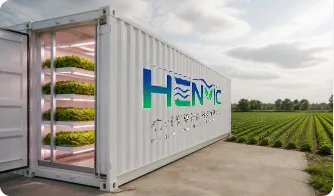
Container farming is often marketed on the strength of its controlled environment, with the implication that sealed production is inherently safer. The environment does reduce some risks — no wildlife intrusion, no rainfall-driven splash dispersal, no adjacent livestock — but it concentrates others, and a food-safety programme built on the assumption of sterility rather than on verified control will fail an audit and, worse, may fail a consumer.
Water is the primary risk vector in any hydroponic or media-based system. Recirculating nutrient solution is an ideal growth medium for bacteria and is in continuous contact with edible tissue; a single contaminated batch can distribute a pathogen across an entire production unit within hours. Control requires source-water testing at defined frequency, treatment of make-up water where indicated (UV, filtration, or chemical where compatible with the nutrient programme), and monitoring of the recirculating loop itself rather than only the inlet. Condensate and recovered drainage should be treated as non-potable until verified.
Environmental monitoring is the second pillar. Surface swabs and ATP testing of harvest tools, crates, benches and door handles give a fast read on sanitation efficacy, while periodic pathogen testing of drains and condensation points addresses the reservoirs that cleaning programmes miss. Drain biofilms and cooling-coil condensate are classical harbourage sites and should be on a scheduled cleaning and verification cycle, not cleaned only when visible soil appears. Airborne risk is lower but not absent: filtration on supply air and positive pressurisation protect the production space, and the pressure cascade should be verified rather than assumed.
Personnel and material flows are the most common audit findings. The container layout should define a clean-to-dirty gradient: harvest product moves outward without re-entering production, waste and spent substrate move on a separate path, and staff who handle waste do not return to the crop without a defined change step. Footbaths, hand-wash stations at entry, and dedicated tools per zone are inexpensive and effective, but only if they are used, which means they must be positioned so that compliance is easier than non-compliance.
Traceability in a container system is a data problem with a physical backstop. Batch identity should be established at seeding and carried through harvest, grading and packing, with the link maintained between physical labels and the production record. Because container systems already log climate, irrigation and dosing data, the traceability record can be genuinely rich: a lot can be associated with the specific nutrient batch, the photoperiod schedule, harvest crew and sanitation events of its cycle. That data has value beyond compliance, since it allows a quality deviation to be correlated with a control parameter rather than investigated blind.
The regulatory frame varies by jurisdiction, but the substantive requirements converge: a written food-safety plan with hazard analysis, documented sanitation standard operating procedures with verification records, supplier approval for seed and substrate, water testing, pest and environmental monitoring, employee training, and a recall procedure that has been tested rather than merely written. Third-party audit schemes add structure and a common vocabulary that buyers recognise.
The cultural point is that a container's advantage is auditability, not immunity. Every parameter that makes the environment controllable also makes it recordable, and the operators who treat that record as an operational tool — reviewing deviations weekly, closing corrective actions, trending sanitation results — end up with both a cleaner audit and a more stable crop. The ones who treat documentation as paperwork for the auditor discover that the same gaps that fail an inspection also explain their intermittent quality problems.