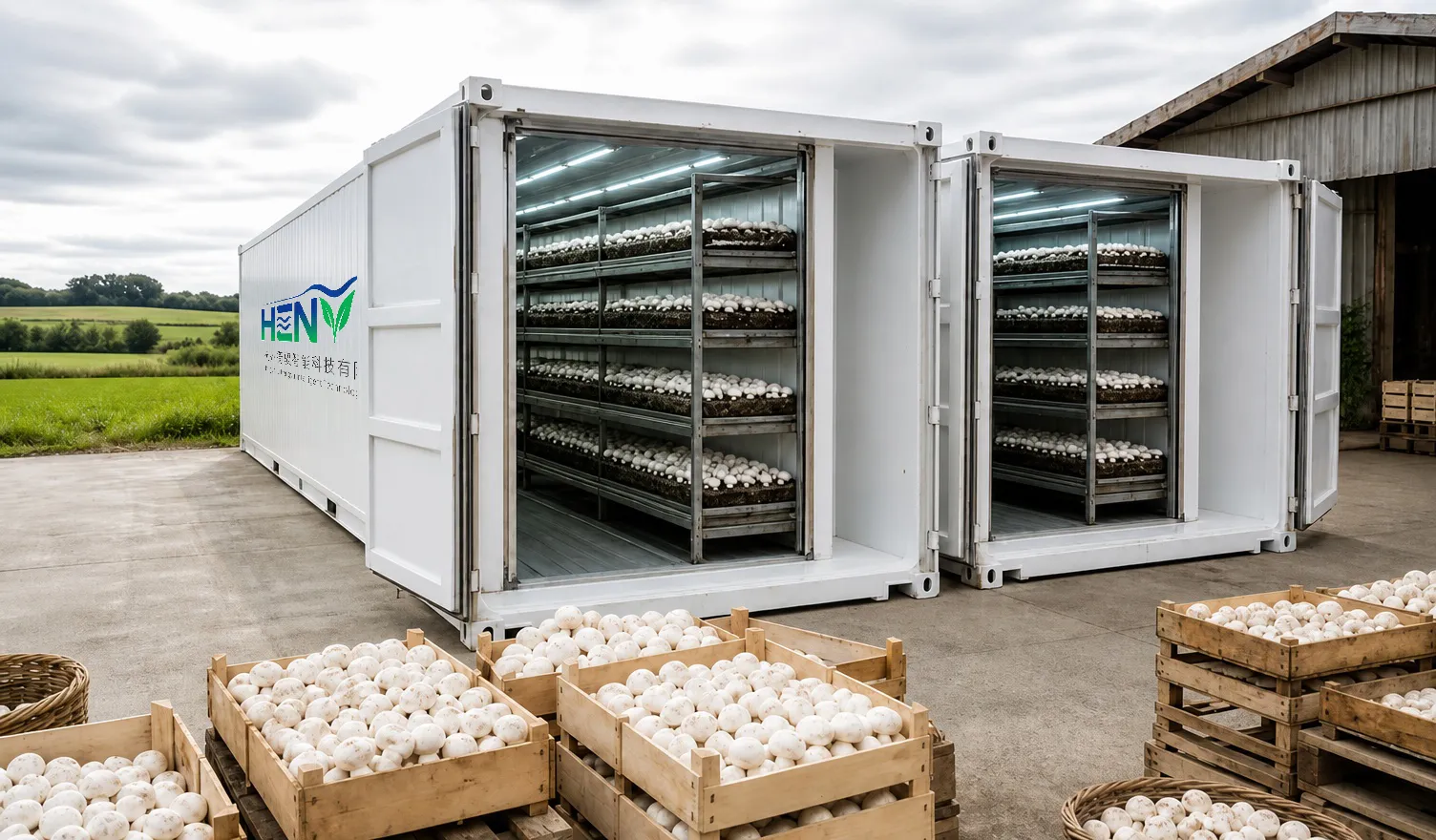
"A mushroom container" is a category rather than a specification. The genus and species determine the temperature range, the substrate, the length of each phase, the tolerance for carbon dioxide, the shelf life, the labour profile and, ultimately, whether the economics work. Selecting the crop before configuring the box is the discipline that separates viable projects from expensive demonstrations.
Oyster Mushrooms
Pleurotus species — grey, blue, pink, king — are the default container crop, and for good reason. They colonise aggressively and outcompete many contaminants, they fruit quickly, with a colonisation period of two to three weeks and a first flush within days of induction, and they tolerate a wide band of temperature and humidity. They are also adaptable to a range of substrates, including straw, cottonseed hulls, hardwood sawdust and spent coffee grounds, which simplifies sourcing.
The container setpoints are moderate: colonisation at 22 to 25 degrees Celsius, fruiting at 15 to 20 degrees, humidity at 85 to 90 per cent, and CO2 held low to prevent stipe elongation unless a specific morphology is wanted. Yields span multiple flushes, with the first typically accounting for the largest share.
Two caveats deserve attention. Oyster mushrooms release heavy spore loads, and the spores are a recognised respiratory sensitiser. Exhaust filtration and protective equipment for harvest staff are not optional refinements. And their soft texture and high water content mean shelf life is short, which pushes the commercial model toward short, frequent delivery cycles.
Shiitake
Shiitake is a slower, more valuable crop with stricter requirements. Colonisation of supplemented hardwood sawdust blocks takes considerably longer — six to twelve weeks is not unusual — and the blocks need a period of maturation before they will fruit reliably. Fruiting demands a sharper temperature drop and, in many strains, a physical or thermal shock to initiate.
Shiitake is also more sensitive to carbon dioxide and to fluctuations in humidity; the fruiting bodies are prone to developing thick, dark, cracked caps in dry air or long stems in stale air. Because colonisation occupies the container for many weeks before any yield appears, shiitake suits a facility with multiple chambers and staggered scheduling rather than a single box, and its higher price per kilogram must carry the longer occupancy.
Lion's Mane
Hericium erinaceus is high value, morphologically distinctive and increasingly in demand in both culinary and nutraceutical channels. It fruits as a single, compact, cascading white mass rather than in clusters, tolerates relatively high humidity, and is less tolerant of temperature variation than oyster species.
The commercial appeal is the price point; the operational difficulty is that lion's mane is more sensitive to contamination during colonisation and to fluctuations during fruiting. It also bruises readily, so handling discipline at harvest is significant. It belongs in a container programme that already has clean-room discipline and reliable environmental control, not in a first installation.
Enoki
Enoki demonstrates how completely environmental manipulation can reshape a crop. Cultivated in bottles rather than bags, enoki mycelium is allowed to colonise, then exposed to a cold shock and deliberately held at elevated carbon dioxide — often in the low thousands of parts per million — with low light. The elevated CO2 suppresses cap expansion and drives stem elongation, producing the long, slender, white bundles that consumers expect. Without this manipulation, the fungus would produce short-stemmed fruit with fully open caps, which is entirely acceptable biologically and entirely unacceptable commercially.
Enoki therefore illustrates a general principle: in a controlled environment, morphology is a controllable variable and market specifications often dictate its setting. It also requires precise CO2 control, since drift produces visual defects that make the product ungradeable.
Button and Specialty Agaricus
Button mushrooms follow a different production model entirely. They grow on composted substrate that has passed through a controlled composting and pasteurisation process, and they require a casing layer — a top dressing of peat or similar material — to provide the physical and microbiological conditions for pinning. They tolerate darkness completely and are typically grown in purpose-built houses with deep beds rather than in containers.
Attempting to grow Agaricus in a vertical racking container is possible but awkward, because the casing layer and the compost regime do not translate well to a shallow tray system. The species is best considered outside the container format unless a specific product niche justifies the engineering.
Substrate as a Selection Constraint
Species choice and substrate choice are coupled. Oyster mushrooms thrive on pasteurised straw, which requires less energy-intensive preparation than sterilised sawdust. Shiitake and lion's mane generally demand supplemented sawdust blocks sterilised at 121 degrees Celsius, which means an autoclave or retort, higher energy input and a stricter sterile workflow. Some species can be grown on spent coffee grounds or agricultural residues, which lowers input cost but introduces variability in moisture, particle size and contamination load.
Whatever the substrate, two parameters require consistency: moisture content and particle structure. Both determine how the mycelium spreads and how the block behaves during fruiting.
How to Choose
A disciplined selection sequence starts with the market rather than the biology. Establish what customers will buy, at what price, and in what volume and frequency. Then work backward to species, then to substrate and preparation method, then to container setpoints and phase durations, and finally to capacity.
Along the way, three questions filter most candidates effectively. How long does the crop occupy the box before first yield? How tolerant is it of the deviations a real control system will inevitably exhibit? And how does it behave after harvest — shelf life, bruising, packaging requirements? A species that colonises for ten weeks and bruises on contact can be profitable at a high price point and ruinous at a moderate one.
The container does not make difficult species easy. It makes well-chosen species repeatable. The choice of what to grow remains the most consequential decision in the project, and it is made before a single panel is bolted together.